From Restoration to "Masar"
The journey of Saudi care for the Sacred Mosque over a century
Introduction
From the day King Abdulaziz Al Saud (may Allah have mercy on him) entered Makkah al-Mukarramah, the Saudi state's attention to the Sacred Mosque has not stopped for a single day. What began as simple restorations and repairs grew, over a full century, into one of the largest architectural and religious expansion projects in modern Islamic history, reaching from the stones of the mosque itself to the streets and railways of Makkah. This article documents that long journey, from the first restoration to the newest urban project now under way.
Where the care began: the reign of the founder, King Abdulaziz
After entering Makkah al-Mukarramah, King Abdulaziz (may Allah have mercy on him) announced the start of comprehensive restorations of the Sacred Mosque and formed a dedicated board to administer the Haram. Among his most notable works in this period were establishing a house for making the Kiswa of the Holy Kaaba in the Ajyad district, crafting a door for the Holy Kaaba, and building a canopy over the Mas'a to shield pilgrims from the heat of the sun. These works were the foundation on which all the major expansions were later built.
The first Saudi expansion (reign of King Saud, continuing until King Khalid)
This expansion began by order of the founding king, was completed by Kings Saud and Faisal, and was followed by the expansion of the eastern courtyards under King Khalid (may Allah have mercy on them all). The first expansion included building the two-storey Mas'a, enlarging the Mataf, moving the Zamzam well to an underground basement, and building minarets, as well as opening gates to the Haram, the best known being King Abdulaziz Gate, the Umrah Gate and the Salam Gate.
The second Saudi expansion (reign of King Fahd)
King Fahd bin Abdulaziz (may Allah have mercy on him) prepared for this expansion by acquiring the properties of the Small Market (al-Suq al-Saghir) west of the Sacred Mosque and compensating their owners. The foundation stone of the second expansion was then officially laid on the western side of the Haram, between the Umrah Gate and King Abdulaziz Gate. The expansion building had several levels, including the basement and the roof, plus outdoor courtyards and a full central air-conditioning system. The built area of the Haram building before the third expansion was about 356,000 square metres, holding about 600,000 worshippers including the Mas'a and the courtyards. Other achievements of this reign include the comprehensive restoration of the Holy Kaaba and the installation of a pure gold Mizab (waterspout), and the renewal of Maqam Ibrahim with its enclosure clad in brass, gold and crystal.
The third Saudi expansion (begun under King Abdullah, continuing under King Salman)
As the numbers of pilgrims and Umrah performers kept growing, King Abdullah bin Abdulaziz (may Allah have mercy on him) ordered the start of the largest expansion project the Sacred Mosque has seen in its history, developing the Haram on every front: architectural, technical and security. Among the most notable achievements of this phase were the expansion of the Mas'a, as well as the largest expansion of the Prophet's Mosque in Madinah in its history and the Prophet's Mosque umbrellas project.
The Custodian of the Two Holy Mosques, King Salman bin Abdulaziz, continued this project and inaugurated main projects within it: the main expansion building, the courtyards project, the pedestrian tunnels project, the central services station project for the Sacred Mosque, and the First Ring Road around the Sacred Mosque area. Among the most notable components of this expansion are a new Mataf building, which raised its capacity to up to 107,000 people performing Tawaf per hour, plus additional northern courtyards for prayer, and giant umbrellas that open and close automatically over the Hasawat area between the old mosque and the first expansion.
According to the General Authority for the Care of the Affairs of the Grand Mosque and the Prophet's Mosque, the third expansion covers about 1.5 million square metres and holds up to 1.25 million worshippers at one time. This immense work serves one of the goals of Saudi Vision 2030: preparing to receive 30 million Umrah performers by 2030.
The Kiswa of the Holy Kaaba: from import to national industry
Saudi care for the Sacred Mosque did not stop at its stones and courtyards; it reached one of its most sacred symbols: the Kiswa of the Holy Kaaba. Until the beginning of the last Hijri century, the Kiswa was made outside the Arabian Peninsula and sent each year, and its dedication text bore the name of the body that made it there. A historic Saudi decision changed this completely.
The start of national production under the founding king: After the Kiswa was no longer being sent, King Abdulaziz Al Saud (may Allah have mercy on him) saw the need to make a Kiswa for the Holy Kaaba without delay. It was made of fine black broadcloth lined with strong fabric, and its verses were written in silver thread plated with gold. King Abdulaziz then issued an official order establishing the first Saudi house dedicated to making the Kaaba's Kiswa. A site was chosen for it in the Ajyad district of Makkah al-Mukarramah, making it the first workshop for weaving the Kaaba's Kiswa in the Arabian Peninsula from the time of the Prophet until then.
Equipping the Jarwal factory under King Saud: King Saud bin Abdulaziz (may Allah have mercy on him) ordered a new factory to be equipped for the Kaaba's Kiswa and entrusted the task to his brother, Prince Faisal (later King Faisal), who assigned the Minister of Hajj and Awqaf, Hussein Arab, to select a building belonging to the Ministry of Finance in the Jarwal area of Makkah al-Mukarramah. The first Kiswa made entirely in this new factory was completed in 1962 CE (1382 AH), and it carried a dedication text quite unlike what had gone before: "This Kiswa was made in Makkah al-Mukarramah and presented to the Holy Kaaba by the Custodian of the Two Holy Mosques, Saud bin Abdulaziz Al Saud." This was a symbolic turning point: the making of the Kiswa had moved entirely from abroad to the land of the Two Holy Mosques.
The move to Umm al-Joud and continuous development: King Faisal and then King Khalid (may Allah have mercy on them) continued to support this industry and develop its facilities, until the factory moved to its new and larger building in the Umm al-Joud area of Makkah al-Mukarramah, equipped with the most advanced weaving and embroidery machines of the time. Under King Fahd bin Abdulaziz (may Allah have mercy on him), the factory expanded considerably and introduced modern mechanical work in place of total reliance on hand weaving. Under King Abdullah bin Abdulaziz (may Allah have mercy on him), its electronic systems and electrical and mechanical equipment were fully modernised to keep pace with the latest industrial technology.
The current name under King Salman: The Custodian of the Two Holy Mosques, King Salman bin Abdulaziz, approved officially renaming the factory "King Abdulaziz Complex for the Kiswa of the Holy Kaaba", honouring the name of the founding king (may Allah have mercy on him), who laid the foundation of this national industry almost a century earlier.
The complex today: The King Abdulaziz Complex for the Kaaba Kiswa has integrated departments covering every stage of production: the belt (Hizam) department, the sewing department, the dyeing department, the printing department, the machine weaving department, the hand weaving department and the technical laboratories, and nearly 200 qualified and trained Saudi workers are employed there. Making the Kiswa uses 850 kilograms of raw silk, dyed inside the complex, and 120 kilograms of gold wire and 100 kilograms of silver wire for the embroidery. Alongside the outer Kiswa of the Kaaba, the complex also produces the inner Kiswa of the Holy Kaaba, the inner covering of the Prophet's Chamber, and the official flags of the Kingdom.
With this transformation, the Kiswa of the Sacred House of Allah is no longer imported from abroad; it has become a purely Saudi national industry, woven by Saudi hands on the soil of Makkah al-Mukarramah itself, a scene that sums up the shape of Saudi care for the Two Holy Mosques: taking charge of every detail of the House of Allah with the highest degree of mastery and national sovereignty.
The newest project in the care of Makkah: the Masar destination
Alongside the direct expansion of the mosque itself, Makkah al-Mukarramah is today witnessing one of the largest integrated urban projects in its history: the Masar destination, developed by Umm Al-Qura for Development and Construction Company.
The project lies in the western part of Makkah al-Mukarramah.
The project aims to develop the western entrance to Makkah al-Mukarramah through an integrated network of road lanes and pedestrian walkways, connected to advanced transport buses.
The newest urban announcement: the King Salman Gate project
On 23 Rabi' al-Akhir 1447 AH, corresponding to 15 October 2025 CE, His Royal Highness Prince Mohammed bin Salman bin Abdulaziz, Crown Prince, Prime Minister and Chairman of the Board of Directors of Rua Al-Haram Al-Makki Company, announced the launch of the "King Salman Gate" project, the newest major addition to the urban development surrounding the Sacred Mosque.
The project covers a total built-up area of up to 12 million square metres, on a strategic site directly next to the Sacred Mosque. It aims to bring a step change in the development of the infrastructure of Makkah al-Mukarramah, and of the Central Area in particular, so that it becomes a global model for urban development around major religious sites. One of its most distinctive features is that it adds new capacity for about 900,000 more worshippers, spread between indoor prayer halls and outdoor courtyards, along with integrated residential, cultural and service facilities directly surrounding the Sacred Mosque, and a direct link to public transport for easier access.
The project has not overlooked the heritage of Makkah al-Mukarramah: it includes developing and rehabilitating about 19,000 square metres of the city's cultural and historical areas, preserving its long-standing identity and enriching visitors' cultural experience alongside their religious one. The project is being developed by Rua Al-Haram Al-Makki Company, one of the Public Investment Fund's companies, which focuses on sustainable resource management and innovative solutions in real estate development according to the best international standards.
Economically, the project is directly linked to the Saudi Vision 2030 targets for economic diversification, as it is expected to help create more than 300,000 jobs by 2036 CE, making it one of the largest urban and economic development projects serving those who come to the Sacred House of Allah in modern times.
Extending the service to transport: the Haramain High-Speed Railway
Care for the Guests of the Most Merciful is no longer confined to the area of the Haram itself; it now extends to an integrated transport system linking the holy cities to one another. The Haramain High-Speed Railway is the most prominent part of this system: it runs for 453 kilometres through five main stations: Makkah al-Mukarramah, Madinah al-Munawwarah, Jeddah (al-Sulaimaniyah station), King Abdullah Economic City, and King Abdulaziz International Airport. The train runs at an operating speed of up to 300 kilometres per hour, which makes it one of the ten fastest electric trains in the world, and it covers the full distance between Makkah and Madinah in just two hours and a quarter, while the journey from Jeddah airport to Makkah station takes only about 50 minutes.
The train went through a trial operation phase between 2018 and 2020, during which it carried about one million passengers on 3,000 trips, before full operation began on 31 March 2021 CE. By the end of 2025 it had carried more than 30 million passengers. The train currently runs a fleet of 35 electric trains, each with a capacity of 417 passengers across 13 carriages (4 business class, 8 economy class, and a restaurant car). During the Hajj season of 1447 AH alone, Saudi Arabia Railways (SAR) prepared an operating plan of more than 5,300 trips and more than 2.21 million seats, with more than 142 trips a day, and during this period the train carried more than 800,000 passengers on more than 3,600 trips. According to Transport General Authority statistics, the Haramain train carried about two million passengers during the first quarter of 2026.
The road and bus network inside Makkah al-Mukarramah
Alongside the train, the Kingdom has developed an integrated internal public transport network through the "Makkah Buses" project, which currently covers 12 main routes and runs 400 buses through 431 stations, over a total distance of 580 kilometres. Since it began operating, the project has carried more than 188 million passengers on more than 4 million trips. In January 2026, a new route was launched linking the Sacred Mosque directly to the Hira Cultural District, home to the Revelation Exhibition and the Holy Quran Museum, a step that reflects the ongoing integration of the cultural dimension into the experience of visitors to the Haram. The third Saudi expansion also included building the First Ring Road directly around the Sacred Mosque area, to ease traffic and relieve congestion around the Haram at peak times.
In summary: one continuous journey
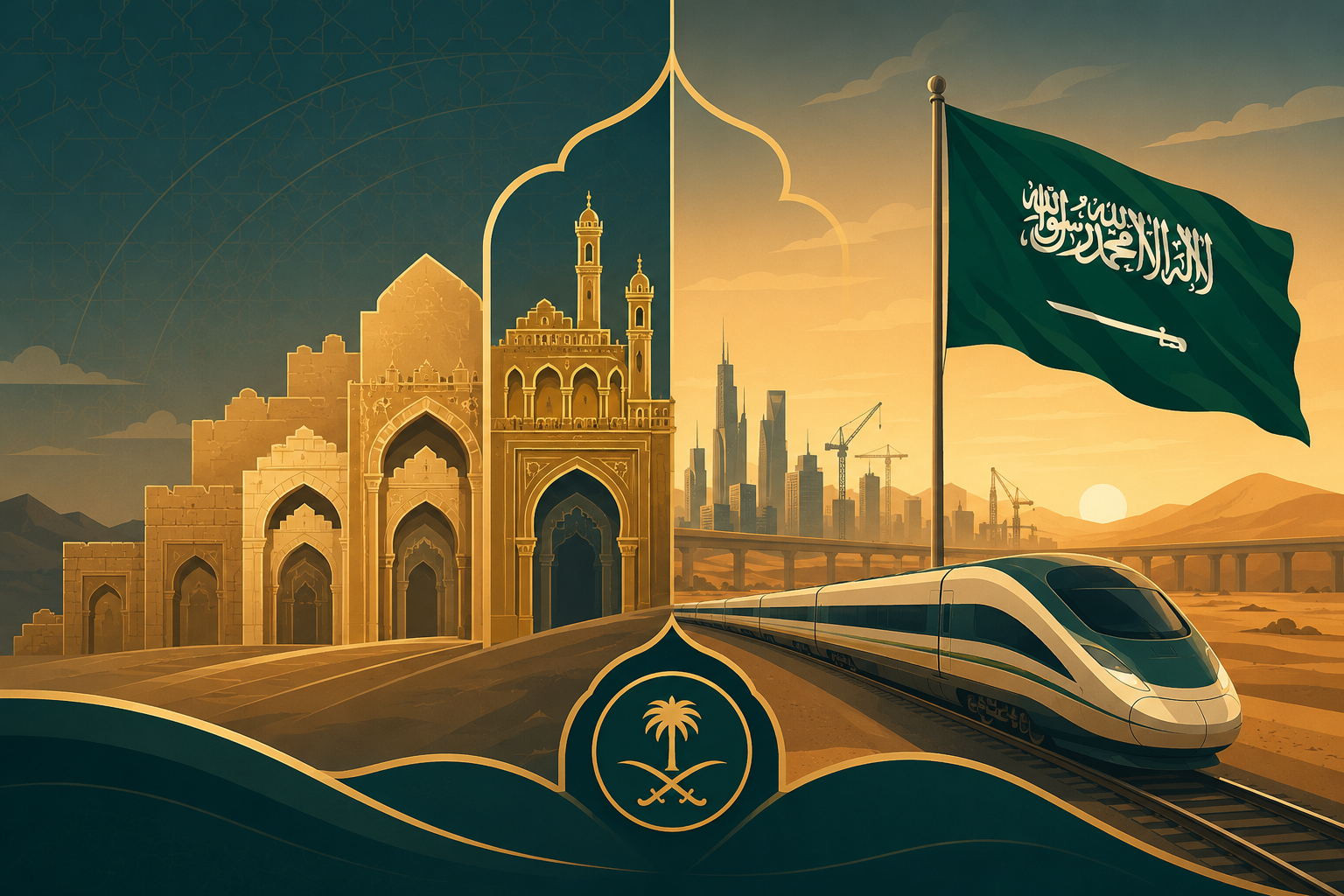
From the restorations of King Abdulaziz, through the first expansion, then the second expansion, the largest of its time, and the third expansion that is still under way today, up to the giant Masar urban project and the Haramain train and Makkah Buses network, it is clear that Saudi care for the Sacred Mosque has never been a finished project but a renewed journey whose goals widen as the numbers of those coming to the House of Allah grow. Every link in this chain, from the stones of the mosque to the rails of the train, serves one shared goal set out by Saudi Vision 2030: that the Guest of the Most Merciful reaches the House of Allah with the greatest ease, comfort and safety.