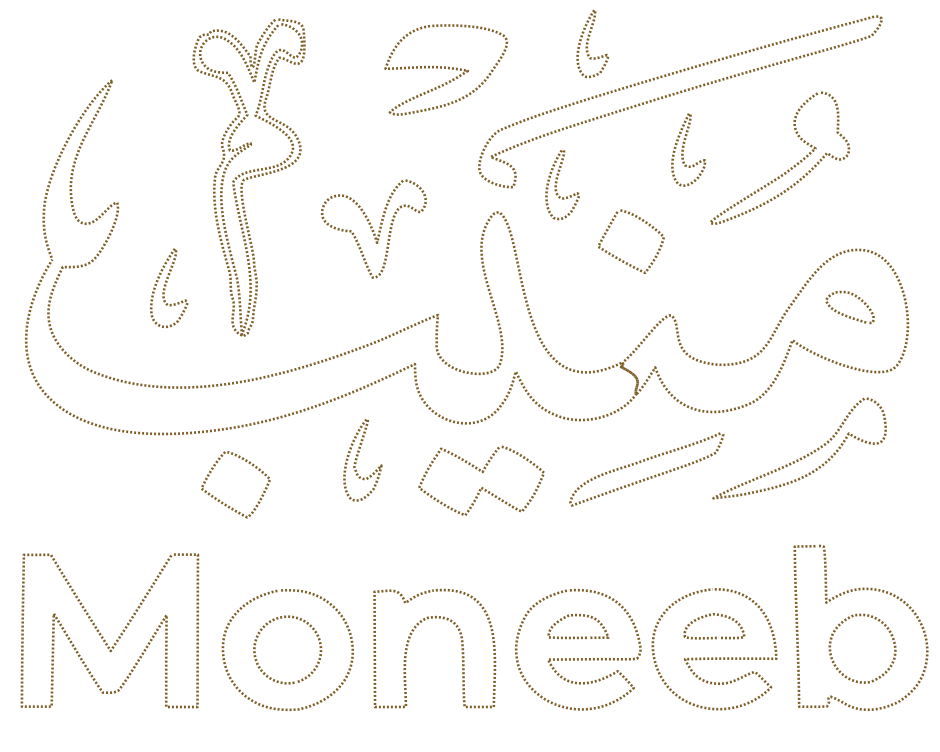
Why "Moneeb"? When a Word from the Qur'an Tells the Story

A simple question that changed the course of a search
"What name suits a platform carrying the trust of the most cherished act of worship every Muslim longs for?" This was the question the founder sat with for a long time, turning through pages of dictionaries and verses of the noble Qur'an, rejecting every name that lacked depth, every word without a real root in our tradition. After an extended search, he settled on one word, and lingered on it for a long while, reading it again and again in the Qur'an until he was certain: "Moneeb" (منيب).
But the story doesn't begin here — it begins with the meaning of the word itself, and its journey through the verses of the noble Book.
At the root of the word: a return that never ceases
Linguists say that "Moneeb" is an active participle from the verb "anaaba" (أناب), and its linguistic root (ن-و-ب) revolves around one beautiful meaning: returning to something again and again. Al-Raghib al-Isfahani writes in Al-Mufradat: "Al-nawb: the returning of something time after time... and inabah (turning) to Allah Almighty is returning to Him through repentance and sincerity of action."
So "the muneeb" (one who turns to Allah) is not someone who returned to their Lord once and then walked away — it is someone who made returning to their Lord a recurring habit that never breaks; returning whenever they stray, coming back whenever they forget — just as the bee returns to its hive, and the traveler returns to their homeland.
Seven occurrences only... and all of them in Makkah
When we traced the word carefully through the noble Qur'an, in its various forms (muneeb, muneeban, muneebeen), we found it appearing in exactly seven places, no more and no less:
"Indeed, Ibrahim was forbearing, imploring, and repentant [muneeb]" [Hud: 75]
"Indeed in that is a sign for every servant turning back [to Allah in repentance, muneeb]" [Saba: 9]
"As a reminder and lesson for every servant turning back [to Allah, muneeb]" [Qaf: 8]
"Who feared the Most Merciful unseen and came with a heart returning [to Him, muneeb]" [Qaf: 33]
"Turning back [muneebeen] to Him, and fear Him and establish prayer" [Ar-Rum: 31]
"When adversity touches the people, they call upon their Lord, turning back [muneebeen] to Him" [Ar-Rum: 33]
"When adversity touches man, he calls upon his Lord, turning back [muneeban] to Him" [Az-Zumar: 8]
Remarkably, when reviewing where each of these seven surahs was revealed, one finds that every single one, without exception, is a Meccan surah: Hud, Saba, Qaf, Ar-Rum, and Az-Zumar — all revealed in Makkah al-Mukarramah, before the migration, during the very period when the call to faith centered on the foundations of monotheism and sincere return to Allah, before the detailed legal rulings that came later in Madinah.
This may well be a beautiful linguistic coincidence, and we do not claim this as a definitive rule of exegesis, but it is a rhetorical observation worth reflecting on: a word entirely built around the meaning of "returning" was never revealed except in the place every Muslim heart returns to — Makkah al-Mukarramah, the land of the first and final return.
Ibrahim: the first to be described as "Moneeb"
And if we look for the most significant of these seven occurrences, none is more telling than the verse in Surah Hud: "Indeed, Ibrahim was forbearing, imploring, and repentant [muneeb]" [Hud: 75].
The very first person the Qur'an describes as "muneeb" is none other than Ibrahim (Abraham), peace be upon him — the father of the prophets, and the builder of the Kaaba by his Lord's command, as stated: "And [mention] when Ibrahim was raising the foundations of the House and [with him] Isma'il" [Al-Baqarah: 127]. A man who spent his life returning to his Lord through every trial: when he was cast into the fire, when he was commanded to sacrifice his son, when he left his wife and infant child in a barren valley without hesitation — then established a House that would remain, until the Day of Judgment, the direction every Muslim turns to five times daily in prayer, and longs to return to whenever able, through Hajj or Umrah.
Is there a more precise meaning for "inabah" (returning) than this? A man who returned, built a House that makes all of creation return to it.
When meaning meets mission
Here the picture comes together completely. The platform "Moneeb," at the core of its mission, serves a single idea: that the Muslim — or whoever performs the rite on their behalf — returns to the House of Allah, time after time, exactly as the linguistic meaning of the word itself describes. And for whoever cannot return with their own body due to incapacity or death, the platform undertakes to restore this honor to them through whoever performs the Umrah on their behalf, so that the meaning of "inabah" remains present in both its name and its service: an unceasing return to the House of Allah, however the means or circumstances may vary.
Moneeb and "naa'ib" — one root carrying both meanings together
Here lies the deeper layer of the story. Returning to the Arabic dictionary, we find that the word "Moneeb" is not limited to the meaning of "one who returns to Allah" alone — its derivational root (ن-و-ب) is the very same root from which the verb "naaba" (ناب) is derived, and from it "naa'ib" (deputy/proxy), "niyabah" (deputation), and "inabah" (delegation). Arabic name dictionaries document that the name "Moneeb" also carries the meaning of "the agent" and "the one standing in as deputy," alongside its original Qur'anic meaning.
This is not a passing linguistic coincidence; the verb "anaaba," from which "Moneeb" is derived, and the verb "naaba," from which "naa'ib" and "niyabah" are derived, both trace back to a single root in the Arabic lexicon, revolving around the meaning of "something standing in place of another, or repeatedly taking its place." In fact, the precise jurisprudential term describing exactly what this platform does — "niyabah in Umrah" or "inabah in Hajj and Umrah" — comes from this very same linguistic root.
In other words: the name "Moneeb" does not only carry the meaning of continuous return to Allah — its very linguistic root also carries the meaning of standing in another's place, of being a deputy on their behalf, of "delegating" oneself to perform what another was unable to do. And this is precisely what the platform does: it becomes "the muneeb" who returns to the House of Allah, on behalf of whoever loved this House and could not reach it themselves.
Conclusion
When the founder chose this name, he wasn't searching for a catchy word — he was searching for a meaning that would summarize everything the idea stands for, from both its angles at once: that returning to the House of Allah remains possible for every returning heart, and that there will always be a trustworthy hand standing in on its behalf when it is unable, carrying its longing, and returning it to the House — even through another's body.
Related articles
Delegation (Al-Inabah) — the general meaning of the word in the Qur'an and Sunnah